

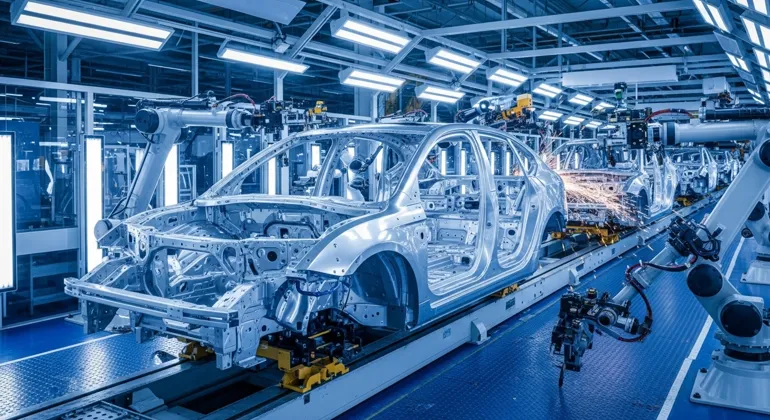
The automotive industry faces a straightforward engineering challenge: reduce vehicle mass without compromising structural integrity, crash safety, or long-term durability. As fuel efficiency regulations tighten globally and electric vehicle (EV) adoption accelerates, material engineers are under increasing pressure to find alloys that deliver reliable performance across a wide range of manufacturing requirements.
Among the aluminum alloys used in automotive production, 6061 aluminum — particularly in the T651 temper — has established itself as a dependable choice for structural components, body systems, and precision-machined assemblies. Its combination of mechanical strength, corrosion resistance, weldability, and machinability makes it one of the most versatile alloys available to automotive engineers today.
Contents
The Industry Push Toward Lightweight Automotive Materials
Automakers worldwide are under regulatory and market pressure to reduce vehicle weight. In conventional internal combustion engine (ICE) vehicles, every 10% reduction in vehicle mass can improve fuel economy by 6–8%. In battery electric vehicles, weight reduction directly extends range — a critical metric for consumer adoption.
Steel has long dominated automotive structures, but its high density (approximately 7.8 g/cm³) limits weight reduction potential. Aluminum, at roughly 2.70 g/cm³, offers a density approximately one-third that of steel, while modern heat-treated alloys like 6061-T651 deliver tensile strengths sufficient for structural automotive applications.
Beyond weight, aluminum offers additional advantages in automotive environments: natural corrosion resistance reduces long-term maintenance requirements, high thermal conductivity supports heat management systems, and recyclability aligns with sustainability goals increasingly required by OEM supply chains.
Why 6061-T651 is Suited for Automotive Manufacturing
The 6061 alloy belongs to the Al-Mg-Si (6000 series) family. Its primary alloying elements — magnesium (0.8–1.2%) and silicon (0.4–0.8%) — combine during artificial aging to form Mg₂Si precipitates, which strengthen the alloy through precipitation hardening. In the T651 temper, the alloy undergoes solution heat treatment, stress relief by controlled stretching, and artificial aging — producing a dimensionally stable product with predictable mechanical properties.
Engineers specifying plate materials for structural automotive components often consult detailed alloy guides — such as this technical overview of 6061-T651 aluminum — to compare temper conditions and verify mechanical performance against design requirements.
Mechanical Properties of 6061-T651 Aluminum
| Property | Typical Value |
| Ultimate Tensile Strength | 310 MPa (45 ksi) |
| Yield Strength | 276 MPa (40 ksi) |
| Elongation | 10–12% |
| Brinell Hardness | 95 HB |
| Density | 2.70 g/cm³ |
| Thermal Conductivity | ~167 W/m·K |
| Elastic Modulus | 69 GPa |
| Machinability Rating | ~90% (relative to free-cutting brass) |
These properties make 6061-T651 particularly suited to automotive environments where components must perform reliably across temperature ranges, resist moisture and road chemicals, and maintain dimensional accuracy throughout a vehicle’s service life.
The alloy’s high machinability rating is also a critical advantage in automotive production. Complex component geometries — such as suspension brackets, engine mounts, and wheel hubs — can be produced efficiently on CNC machining centres, reducing cycle times and tooling costs compared to higher-strength alloys like 7075.
Key Automotive Applications
The combination of strength, corrosion resistance, and fabrication flexibility positions 6061-T651 across multiple automotive subsystems.
Body and Chassis Structures
In modern vehicle architectures — particularly in premium and EV platforms — aluminum space frames and structural nodes are increasingly replacing traditional steel unibody construction. 6061-T651 extruded profiles and machined plates are used in:
- Body frame rails and cross members
- Door impact beams and side sill reinforcements
- Roof bow structures
- Firewall and floor structural panels
- Subframe and cradle assemblies
The T651 stress-relief temper is particularly important for machined structural nodes, which require precise fit tolerances when assembled with fasteners or adhesive bonding systems.
Suspension and Drivetrain Components
Suspension systems demand materials with good fatigue resistance, dimensional stability under cyclic loading, and resistance to road salt and moisture. 6061-T651 is used in:
- Control arms and wishbone suspension links
- Steering knuckles and upright assemblies
- Shock absorber towers
- Engine mount brackets
- Differential housing components
Thermal Management and EV Battery Systems
In electric vehicles, aluminum plays an expanding role in battery enclosure systems and thermal management structures. 6061’s thermal conductivity of approximately 167 W/m·K makes it suitable for:
- Battery enclosure trays and covers
- Heat exchanger plates and coolant manifolds
- Motor housing structural components
- Inverter and power electronics housings
The corrosion resistance and weldability of 6061 are particularly valued in battery enclosure applications, where moisture ingress and long-term sealing integrity are critical safety requirements.
6061 vs 5052 — How to Choose for Automotive Use
Automotive engineers frequently evaluate 6061 and 5052 aluminum when selecting sheet or plate materials for body panels, enclosures, and structural components. While both alloys perform well in automotive environments, they serve different functional requirements.
6061-T651 vs 5052-H32 — Automotive Selection Guide
| Property / Factor | 6061-T651 | 5052-H32 |
| Tensile Strength | 310 MPa | 228 MPa |
| Yield Strength | 276 MPa | 193 MPa |
| Formability | Moderate | Excellent |
| Weldability | Good (TIG/MIG) | Excellent |
| Corrosion Resistance | Very Good | Excellent |
| Machinability | Excellent (~90%) | Good |
| Heat Treatable | Yes | No |
| Best Automotive Use | Structural, machined parts | Sheet panels, fuel tanks |
As a general guideline, 6061-T651 is the preferred choice for load-bearing structural components, machined brackets, and assemblies requiring high strength and dimensional accuracy. Its heat treatability allows procurement teams to specify precise temper conditions for each application.
5052-H32, by contrast, is better suited for sheet metal applications requiring deep drawing, tight bend radii, or extended exposure to salt spray environments — such as fuel tank shells, underbody panels, and body cladding on commercial vehicles. For projects where both formability and corrosion resistance are priorities, 5052-H32 is often the more appropriate specification.
Sourcing and Cost Considerations for Manufacturers
For automotive manufacturers and Tier 1 suppliers, material procurement decisions involve more than alloy specification. Lead times, minimum order quantities, dimensional tolerances, mill certification, and supplier reliability all influence total supply chain cost.
6061-T651 is one of the most widely produced aluminum alloys globally, which generally supports competitive pricing and consistent material availability. Standard forms — including plate, sheet, bar, tube, and extruded profile — are readily available from certified aluminum producers.
Automotive programs operating at scale frequently source aluminum from international suppliers with dedicated automotive material certification capabilities. Working with a reputable Aluminum Manufacturer in China can provide access to competitively priced 6061-T651 plate, extrusions, and bar stock produced to ASTM B209, AMS 2770, and relevant automotive industry standards.
Key sourcing criteria for automotive programs include:
- Mill test certificates (MTC) for each batch, documenting chemical composition and mechanical properties
- Compliance with ASTM, AMS, or EN material standards relevant to the component specification
- Dimensional tolerance control, particularly for precision plate and extruded profiles
- Heat treatment traceability and process documentation
- Established logistics capability for just-in-time delivery to automotive assembly operations
For EV programs in particular, battery enclosure components may require suppliers with additional process certifications related to surface cleanliness, leak-testing capability, and joining process qualification — factors worth evaluating early in the supplier selection process.
Conclusion
6061 aluminum in the T651 temper continues to be a reliable and versatile choice for automotive engineers balancing structural performance, weight reduction, and manufacturing efficiency. Its mechanical properties, corrosion resistance, machinability, and weldability cover a broad range of automotive applications — from body frames and suspension components to EV battery enclosures and thermal management systems.
As the automotive industry continues its transition toward electrification and lighter vehicle architectures, 6061-T651 is well-positioned to remain a core material in both conventional and next-generation vehicle programs. Engineers specifying this alloy benefit from a well-documented material with decades of production history, established supply chains, and broad fabrication process compatibility.
| About the Author James Whitfield is an automotive materials engineer with 15 years of experience in lightweight structures and aluminum alloy selection for passenger vehicle and EV programs. He has worked with OEM and Tier 1 suppliers across North America and Asia, advising on alloy specification, forming processes, and global aluminum procurement strategies. |
Published in partnership with Linsy Aluminum — premiumalu.com · Aluminum Manufacturer in China

Zack Hart
Hey there! I’m Zack Hart, the pun-dedicated brain behind PunsClick.
Based in Alaska, I built this site for everyone who believes a well-placed pun can brighten a dull day.
Whether you’re into clever wordplay or cringe-worthy dad jokes, you’ll find your fix here. We’re all about bringing the world closer — one pun at a time.