

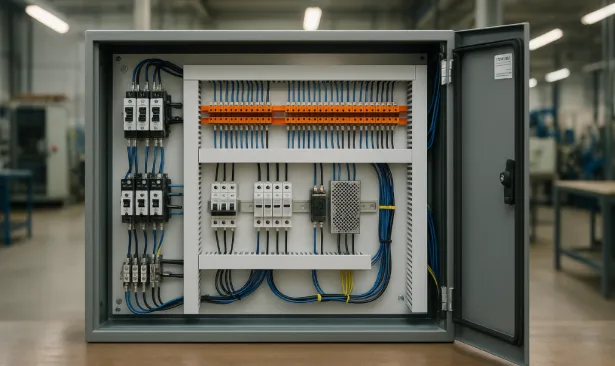
In the world of panel building, ‘good enough’ is a recipe for a Red Tag. Here is how to navigate the essential design requirements of UL 508A to ensure your next project is both safe and compliant.
The UL 508A Label: It’s a Design Process, Not an Inspection Checklist
For industrial professionals in the U.S., the UL 508A certification mark on an industrial control panel signifies compliance with a robust set of safety and performance standards. This certification is a fundamental requirement in North American manufacturing, ensuring the panel is built to withstand operating conditions, protect personnel, and limit fire hazards during fault conditions, as mandated by the NEC. Achieving the label is not the result of a final inspection; it is the cumulative outcome of meticulous design decisions made by the engineer and panel builder.
We must move past simply assembling components and instead focus on the five critical design requirements that frequently lead to compliance failures, especially as panel density increases and design trade-offs become tighter. Ignoring these principles results in delayed installs, costly rework, and potential safety liabilities in the field.
Understanding the Decisive Split: Listed vs. Recognized Components
One of the most persistent areas of confusion is the proper use of UL-certified components. UL 508A requires components to be either UL Listed or UL Recognized and used within their specified ratings.
- UL Listed components are standalone devices, like circuit breakers, disconnects, or drives, that are complete and self-contained. They are intended to be installed in the field or in a factory in accordance with their instructions.
- UL-recognized components, identified by the reversed ‘UR’ mark, are typically sub-components, like terminal blocks, power supplies, or relays, intended only for factory installation within another UL-listed or UL-certified piece of equipment, such as our control panel.
A common error is using a recognized component outside of its tested rating or using components without considering if they are suitable for use with control panel conductors. For a comprehensive breakdown of this critical distinction, understanding the difference between UL recognized and UL listed is paramount for compliance and design integrity. Using these component marks correctly is foundational to achieving the final panel certification.
Air and Creepage: Why We Can’t Afford Compact Designs
While industrial space is always at a premium, engineers cannot sacrifice the minimum electrical clearances mandated by UL 508A Sections 30 and 31. These requirements for Air Spacing (distance through air) and Creepage Distance (distance along an insulating surface) are essential for preventing arcing and tracking failure between uninsulated live parts and grounding surfaces, especially in high-voltage or high-contamination environments.
The minimum required distances vary based on the voltage, but exceeding 150 Volts requires a hard look at spacing. Furthermore, never overlook the wire bending space requirements defined in the NEC and referenced by UL 508A. Cramming large conductors into small terminals without adequate space causes undue strain on the conductor insulation, increasing the risk of insulation failure over time. Always verify that your enclosure depth and gutter space meet the minimum dimensions based on the largest conductor size.
SCCR Calculation: Non-Negotiable System Integrity
As we previously established, the Short-Circuit Current Rating (SCCR) is the maximum fault current the panel can safely withstand. UL 508A, particularly Supplement SB, dictates the calculation methodology, requiring that the panel be marked with the lowest SCCR of any component in the power circuit, unless a higher conditional rating is achieved via a current-limiting OCPD combination.
The crucial decision is whether to design for the common 5 kA default or engineer for a higher, field-required rating (25 kA, 65 kA, etc.). If the Available Fault Current (AFC) is unknown, the installer may legally default to the NEC minimum of 5 kA, but the panel is dangerously underrated in nearly all heavy industrial settings. Prudent engineers specify components that support a high SCCR, such as current-limiting fuses and high-rated disconnects, and provide the calculation on the panel drawing. When making complex design decisions, thoroughly reviewing UL 508A control panel design considerations can help streamline your approach to SCCR.
Wire Sizing and Internal Panel Temperature Management
The final, critical design requirement involves thermal management, which is tied directly to wire sizing and component temperature ratings. UL 508A Table 28.1 governs the minimum conductor sizes for internal wiring. It is essential to note that these ampacity requirements can differ from the general NEC tables.
A common failure is not considering the overall panel temperature rise. Components like power supplies, VFDs, and PLCs generate heat. UL 508A Section 27 dictates that all components must be selected and wired so that their temperature rating is not exceeded under maximum expected operating conditions.
Final Authority: Building Panels that Protect the System
UL 508A compliance is achieved when technical accuracy meets practical application. As professionals, our authority comes from mastering the nuances, from the distinction between listed and recognized components to the rigorous application of spacing and SCCR requirements. By prioritizing these essential design elements upfront, we ensure the final product not only passes the audit but serves its primary function: reliably protecting personnel and equipment in the demanding U.S. industrial environment.

Zack Hart
Hey there! I’m Zack Hart, the pun-dedicated brain behind PunsClick.
Based in Alaska, I built this site for everyone who believes a well-placed pun can brighten a dull day.
Whether you’re into clever wordplay or cringe-worthy dad jokes, you’ll find your fix here. We’re all about bringing the world closer — one pun at a time.