
Close your eyes and imagine your perfect song. Not someone else’s song—*yours*. The one that plays during your most creative moments, the soundtrack to memories you haven’t made yet, the melody that surfaces when you’re driving alone at night. You can hear it completely—the way the bass pulses, how the strings swell in the chorus, the exact moment the drums kick in.
Now try to describe it.
Suddenly, that crystal-clear sonic vision becomes frustratingly abstract. “It’s kind of… energetic but not aggressive. Maybe like… indie rock meets electronic? With a hopeful vibe but also introspective?” You’re grasping for words that don’t quite exist, trying to translate a language of pure feeling into the clumsy vocabulary of adjectives and genre labels.
This is the fundamental problem nobody talks about: music and language are incompatible translation systems. Your brain processes music in regions that handle emotion, pattern recognition, and physical sensation—areas that operate largely below conscious verbal thought. When you try to describe music with words, you’re forcing a multi-dimensional sensory experience through the narrow bottleneck of linear language.
For centuries, this translation barrier has kept musical ideas locked inside people’s minds. If you couldn’t play instruments or read notation, your only option was hiring someone to interpret your verbal descriptions—a process so prone to miscommunication that most people simply gave up. Their songs died untranslated, trapped in a language only they could hear.
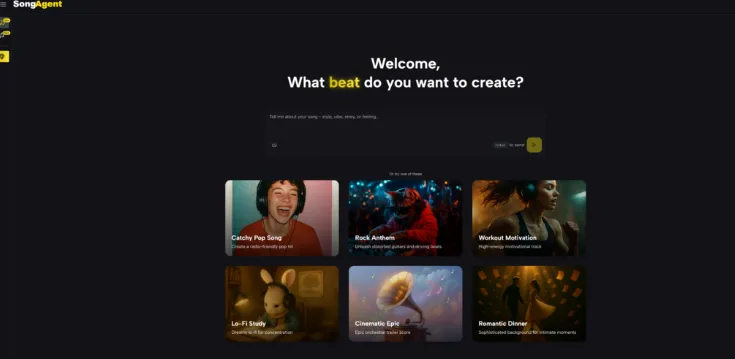
But what if you didn’t need to translate at all? What if you could communicate with a system that understands music’s native language—not through perfect descriptions, but through iterative demonstration, emotional mapping, and collaborative refinement? This is the paradigm shift happening with AI Song Agent technology: moving from translation to interpretation, from commands to collaboration, from describing music to discovering it together.
Contents
Why Words Have Always Failed Music
Think about the last time you tried to explain why you love a particular song. You probably said things like “the energy,” “the vibe,” “how it makes me feel.” These aren’t descriptions—they’re acknowledgments that description is impossible. We resort to metaphors because direct translation doesn’t exist.
The Emotional Complexity Problem: Music communicates emotions that don’t have names. There’s no single word for “the bittersweet nostalgia of remembering something you’re not sure actually happened” or “the specific restlessness of a Sunday evening in late summer.” But music can express these feelings precisely. Words can’t.
The Simultaneous Information Problem: Music delivers multiple information streams simultaneously—melody, harmony, rhythm, timbre, dynamics, spatial positioning. Language is sequential; you can only say one thing at a time. Describing a song is like trying to explain a photograph by listing every pixel individually.
The Subjective Interpretation Problem: Musical terms mean different things to different people. “Aggressive” drumming to a jazz listener might be “moderate” to a metal fan. “Warm” guitar tone, “bright” vocals, “tight” production—these descriptors shift meaning based on the listener’s reference library.
The Technical Vocabulary Gap: Professional musicians have specialized language—Dorian mode, sus4 chords, sidechain compression—but if you don’t speak that language, you’re locked out. You might know exactly what you want sonically, but lack the vocabulary to articulate it.
The Communication Breakdown in Traditional Music Creation
| What You Actually Hear in Your Mind | What You Can Say With Words | What Gets Lost | What You Usually Get | Your Satisfaction Level |
| Specific emotional texture with layered complexity | “Sad but hopeful” | Nuanced emotional balance, intensity gradations | Generic sad-to-happy progression | 30-40% match |
| Precise instrumental blend and spatial arrangement | “Acoustic guitar with some electronic elements” | Ratio of elements, production style, sonic space | Either too acoustic or too electronic | 40-50% match |
| Dynamic arc with intentional energy shifts | “Starts quiet, builds to energetic” | Pacing, specific build moments, peak intensity | Predictable crescendo structure | 50-60% match |
| Rhythmic feel and groove characteristics | “Upbeat, around 120 BPM” | Swing feel, rhythmic pocket, percussion texture | Metronomic beat without groove | 35-45% match |
| Harmonic sophistication and chord voicings | “Major key, uplifting” | Chord complexity, voice leading, harmonic movement | Simple major chord progressions | 40-50% match |
The table exposes a painful reality: even when you can hear your song perfectly in your imagination, the translation to words typically preserves less than half of your actual vision. The rest evaporates in the gap between hearing and describing.
When Creation Stops Requiring Translation
Last spring, I needed music for a personal project—a video montage of my daughter’s first year. I could hear exactly what I wanted: something that captured the overwhelming tenderness of new parenthood, but also the exhaustion, the humor in the chaos, the way time feels both endless and impossibly fast.
How do you describe that to a musician? I tried: “Warm, intimate, acoustic-based, emotionally complex, tender but not sentimental, with moments of playfulness.” Even as I wrote it, I knew these words were inadequate shadows of what I was actually hearing.
With traditional AI music tools, I would’ve generated dozens of tracks from various prompt combinations, hoping one randomly matched my internal vision. It’s the musical equivalent of buying lottery tickets—statistically, something might eventually work, but the process is frustrating and imprecise.
The AI Song Agent approach felt fundamentally different. Instead of demanding I perfectly describe my vision upfront, it engaged with my imperfect descriptions:
My attempt: “I need music that feels like… the emotional complexity of new parenthood. Tender but real, not overly sentimental.”
System’s response: “That’s a nuanced emotional space. Let’s explore it together. When you say ‘tender but real,’ are you thinking of intimate instrumentation like acoustic guitar or piano? Should there be moments of lightness or humor reflected musically? And for ‘not overly sentimental’—does that mean avoiding strings, or just using them sparingly?”
This wasn’t a system demanding perfect input—it was a collaborator helping me discover what I actually wanted. Through the conversation, I realized I wanted primarily piano and acoustic guitar, with subtle electronic textures for the “surreal” quality of sleep deprivation. I wanted major key but with some unexpected chord changes to avoid saccharine simplicity. I wanted space in the arrangement—room to breathe, like the quiet moments between chaos.
The system generated a musical blueprint based on our conversation. I could see the proposed structure before hearing a single note. When it created the first version, it was maybe 70% there—closer than I’d ever gotten with stock music or prompt-based generators.
“The opening is perfect, but the middle section feels too busy—can we simplify it?” It adjusted. “Yes, but now it needs something to maintain interest—maybe a subtle melodic variation?” It refined. Six iterations and about 40 minutes later, I had exactly what I’d been hearing in my mind.
What struck me wasn’t just the end result—it was that the process felt like discovery rather than *description*. I didn’t need to perfectly translate my vision into words. I needed a collaborator who could interpret my imperfect attempts and help me refine them into clarity.
What Becomes Possible Without the Translation Barrier
For the Verbally Challenged: Some people simply aren’t good at describing things with words. They’re visual thinkers, emotional processors, or just not naturally articulate. Traditional music creation punished this—if you couldn’t describe your vision eloquently, you couldn’t create it. Conversational systems meet you where you are, asking clarifying questions rather than demanding perfect initial descriptions.
For Evolving Visions: Sometimes you don’t know exactly what you want until you hear what you don’t want. Traditional methods make exploration expensive—each iteration costs time or money. When I was developing theme music for a podcast, I started with one direction, heard it, realized it was wrong, and pivoted completely. The conversational approach made that exploration affordable and rapid.
For Emotional Precision: In my experience, the biggest advantage is emotional specificity. When I needed music that felt like “bittersweet acceptance”—not sad, not happy, but that specific complex emotion—the dialogue helped narrow in on it. “Should the bittersweetness lean more melancholic or more peaceful?” These questions helped me articulate feelings I couldn’t name.
For Learning Your Own Taste: Here’s something unexpected: the conversation teaches you about your own preferences. When the system asks, “Do you want the energy to build gradually or have a sudden shift?” you’re forced to consider what you actually prefer. Over time, you develop better understanding of your own musical taste and how to articulate it.

The Honest Reality of What This Can’t Do
I’d be misleading you if I suggested this technology eliminates all challenges. It doesn’t. Here’s what I’ve learned through actual use:
You Still Need Some Clarity: The system can work with imperfect descriptions, but it can’t work with no direction. If your only input is “make me something good,” even conversational AI will struggle. You need at least a general emotional target, use case, or stylistic direction. In my projects, spending 5-10 minutes clarifying my own vision before starting the conversation dramatically improved outcomes.
Iteration Remains Necessary: My average project requires 4-8 conversational exchanges before I’m satisfied. Sometimes I realize my own description was unclear. Sometimes the system’s first interpretation misses the mark. The process is faster and more guided than traditional methods, but it’s not instantaneous magic. Budget time for refinement.
Complex Musical Concepts Challenge the System: When I tried creating something with unusual time signatures and experimental structure, the results were inconsistent. The technology excels within established musical frameworks but can struggle with avant-garde approaches. If your vision is genuinely experimental, you might still need human musicians who can intentionally break rules.
The Originality Question: Because these systems learn from existing music, they tend to produce competent genre executions rather than groundbreaking innovations. For functional music—backgrounds, intros, soundtracks—this works beautifully. For artistic statements that push boundaries, the technology supports but doesn’t replace human creative vision.
Vocal Tracks Remain Variable: In my testing, purely instrumental pieces consistently sound professional. Vocal tracks are more hit-or-miss—some sound remarkably natural, others have subtle artificial qualities. If vocals are central to your project, expect more iteration and potentially some compromise on naturalness.
Choosing the Right Path for Your Musical Vision
The question isn’t whether AI Song Agent technology is “better” than traditional music creation—it’s whether it solves your specific problem.
This approach makes sense when:
- You can hear your vision clearly but struggle to describe it perfectly
- You need to explore options quickly without expensive iteration
- Your project requires functional music rather than artistic innovation
- You value creative control over the collaborative interpretation of others
- Budget or timeline constraints make traditional methods impractical
Traditional paths remain better when:
- Your vision requires genuinely experimental or boundary-pushing approaches
- You have the budget and timeline for professional collaboration
- The human element—spontaneity, imperfection, artistic interpretation—is central to your vision
- You’re seeking to build relationships and learn from other musicians
- Your project demands the absolute highest level of musical sophistication
For most people with musical ideas trapped in their imagination, the honest comparison isn’t “AI versus human musicians”—it’s “AI-enabled creation versus those ideas remaining forever untranslated.”
Your Music Doesn’t Need Perfect Words
What I’ve learned through creating with Song Agent technology is this: the barrier was never your inability to create music—it was the requirement that you translate your musical imagination into words before you could create it.
That song in your head speaks its own language—a language of feeling, texture, energy, and emotion. For the first time, you don’t need to become fluent in verbal description to bring it into reality. You need a collaborative partner who can interpret your imperfect attempts, ask clarifying questions, and help you discover what you’re actually hearing.
Your music has been waiting—not for perfect words, but for a conversation that doesn’t require them.
Maybe it’s time to stop translating and start creating.

Zack Hart
Hey there! I’m Zack Hart, the pun-dedicated brain behind PunsClick.
Based in Alaska, I built this site for everyone who believes a well-placed pun can brighten a dull day.
Whether you’re into clever wordplay or cringe-worthy dad jokes, you’ll find your fix here. We’re all about bringing the world closer — one pun at a time.