

As fleet vehicles and emergency response platforms become more electrically demanding, operators are asking a more strategic question:
Is it time to move from 12V to 24V?
For decades, 12V systems have powered light-duty trucks, vans, and contractor vehicles. But modern fleet builds are no longer simple ignition and lighting systems. Today’s platforms support inverters, liftgates, medical equipment, scene lighting, telematics, refrigeration, and mobile command electronics.
As power demand increases, so does current draw — and that is where system voltage becomes a serious design decision.
This is not about trends. It is about efficiency, current management, heat, recovery speed, and long-term reliability.
Contents
Understanding the Core Difference
The difference between 12V and 24V systems comes down to amperage.
For the same power demand:
A 12V system requires twice the amperage of a 24V system.
Power equals volts multiplied by amps.
If a fleet vehicle is running a 3,000W inverter:
At 12V → approximately 250 amps
At 24V → approximately 125 amps
Cutting current in half affects cable size, heat generation, voltage drop, fuse sizing, and charging efficiency.
In fleet environments with long cable runs and high loads, that reduction in amperage can dramatically improve system stability.
When 12V Makes Sense in Fleet Applications
A 12V system remains ideal for:
- Light-duty service vans
- Standard contractor trucks
- Municipal pickups
- Vehicles with moderate inverter loads
- Battery banks under 400Ah
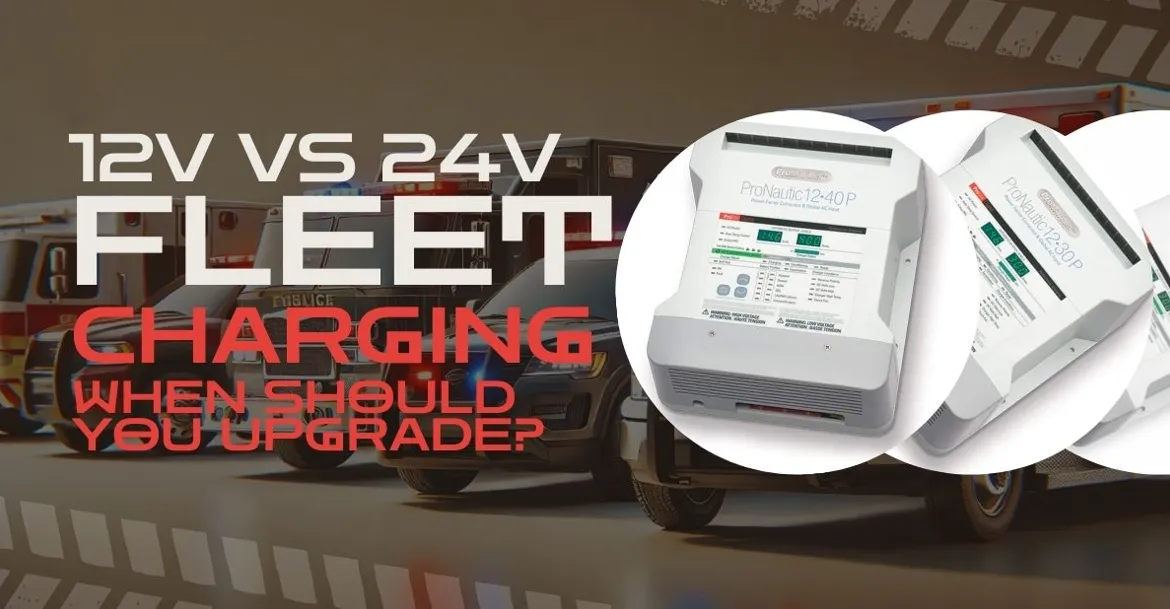
If the electrical demand is limited to lighting, moderate inverter usage, and accessory power, a properly sized Promariner marine battery charger such as the ProNautic 1240P is more than capable of maintaining performance.
The Promariner battery charger lineup — particularly the ProNautic Series — supports AGM, GEL, flooded, and LiFePO4 batteries with:
- Digitally controlled multi-stage charging
- Distributed-On-Demand™ technology
- Temperature compensation
- Energy Saver Mode
For many fleet operators, upgrading voltage simply is not necessary if the system is properly engineered and paired with the correct Promariner marine battery charger.
When 24V Becomes the Smarter Fleet Choice
Upgrading to 24V becomes practical when:
- Battery banks exceed 400–500Ah
- Inverter loads exceed 3,000W
- Cable runs are long
- Vehicles operate extended duty cycles
- Heat buildup becomes noticeable
- Voltage sag affects electronics
This is common in ambulances, fire command vehicles, mobile surveillance units, utility bucket trucks, refrigerated transport trucks, and heavy municipal fleet platforms.
Because 24V cuts current demand in half, it reduces heat in conductors, improves voltage stability, allows smaller cable gauge, and improves charging recovery time.
For 24V systems, models within the Promariner marine battery charger family such as the ProNautic 2430P or ProNautic 2440P are designed to handle higher-capacity banks while maintaining intelligent battery management.
In high-demand fleet builds, 24V combined with the right Promariner battery charger delivers cleaner and more stable power under load.
Charging Strategy Matters
Changing voltage without upgrading the charging infrastructure is where many systems fail.
A 12V fleet charger typically focuses on fast recovery for moderate banks, compact mounting inside vehicle compartments, and simple shore-power integration.
A 24V fleet charger is usually found in emergency response vehicles, heavy-duty fleet trucks, municipal equipment, and vehicles with large auxiliary banks.
The Promariner battery charger ProNautic Series includes:
- Twelve selectable charging profiles
- Self-test diagnostics
- Automatic temperature compensation
- Distributed-On-Demand™ bank management
- Energy Saver Mode
Upgrading voltage requires upgrading the charging platform accordingly. The charger must match the electrical architecture.
Recovery Time and Duty Cycle
Emergency and fleet vehicles often operate in cycles: run lighting and electronics, discharge auxiliary banks, return to station, and recharge quickly before the next deployment.
Voltage affects recharge speed.
24V systems can accept higher total wattage through the same infrastructure, allowing faster recovery and reduced downtime.
However, if vehicles remain parked with long access to shore power, a higher-output Promariner marine battery charger such as the ProNautic 1260P may provide sufficient recovery without requiring voltage conversion.
Lithium Batteries Change the Equation
LiFePO4 batteries accept higher charging currents and recover faster.
Because lithium can handle higher amperage safely, some fleet operators remain at 12V and simply increase charger output.
In these cases, upgrading within the Promariner battery charger ProNautic lineup may eliminate the need to convert the entire system to 24V.
Voltage upgrade is not mandatory simply because lithium is installed. The decision should solve a measurable performance issue — not create unnecessary complexity.
Build Smarter with 12VoltPower
Whether you operate contractor vans, ambulances, municipal trucks, or heavy fleet equipment, choosing the right charging voltage directly impacts reliability and uptime.
Explore professional-grade solutions from a trusted Promariner marine battery charger collection at 12VoltPower and design your system for performance, stability, and long-term durability.

Zack Hart
Hey there! I’m Zack Hart, the pun-dedicated brain behind PunsClick.
Based in Alaska, I built this site for everyone who believes a well-placed pun can brighten a dull day.
Whether you’re into clever wordplay or cringe-worthy dad jokes, you’ll find your fix here. We’re all about bringing the world closer — one pun at a time.